


[ad_1]
New applied sciences usually are launched by way of spectacle: Consider the historic demonstrations carried out by Faraday, Edison, Morse, and Bell, or, extra just lately, by Steve Jobs onstage in his black turtleneck at Macworld 2007, holding the primary iPhone. Certainly, hyped-up product bulletins at business occasions just like the Shopper Electronics Present (now
CES) and the Sport Builders Convention have change into common options of the digital world.
There’s additionally a parallel custom—much less flashy however no much less essential—of business occasions that focus consideration on digital infrastructure. A number of of those occasions, equivalent to the primary public demo of the
ARPANET in 1972, or the mid-Nineteen Eighties conferences now often known as Interop, alerted consultants to new applied sciences, and, in some circumstances, altered the steadiness between competing approaches.
Though many of those gatherings have escaped the eye of historians, our view is that these occasions must be acknowledged extra absolutely as moments the place consultants might glimpse potential futures and decide for themselves what was most probably to occur. Right here we describe just a few of those do-or-die moments. You might not have heard of any of those occasions—however for those who have been there, you’ll always remember them.
Packet Switching Comes of Age
The ARPANET was one of many first networks to use
packet switching, an method to communications that breaks messages into discrete chunks, or packets, of knowledge. It was a significant departure from circuit-switched networks, equivalent to phone networks, for which communication companions have been linked by way of a devoted circuit.
The primary node of the ARPANET was put in on the College of California, Los Angeles, in 1969. However the ARPANET didn’t take off instantly. And by mid-1971, program director
Lawrence Roberts of the Superior Analysis Initiatives Company (ARPA) was turning into impatient with the sluggish tempo at which ARPA-funded researchers have been getting related. One in every of these researchers, Bob Kahn, urged that Roberts set up a public demonstration of the ARPANET, each to teach different researchers concerning the community’s capabilities and to encourage new companions to assist the initiative. As soon as Kahn discovered a venue for the demo—on the Worldwide Convention on Pc Communications (ICCC), to be held in Washington, D.C., in late October of 1972—he labored feverishly to get it organized.
Kahn recruited about 50 folks to behave as facilitators, together with the ARPA-funded researchers
Vint Cerf, Robert Metcalfe, and Jon Postel, all of whom have been destined for networking fame. Kahn’s plan referred to as for a TIP—quick for Terminal Interface Processor—to be put in on the Hilton Resort, the location of the ICCC. From there, attendees might go browsing to one of many ARPANET hosts and run an software remotely.
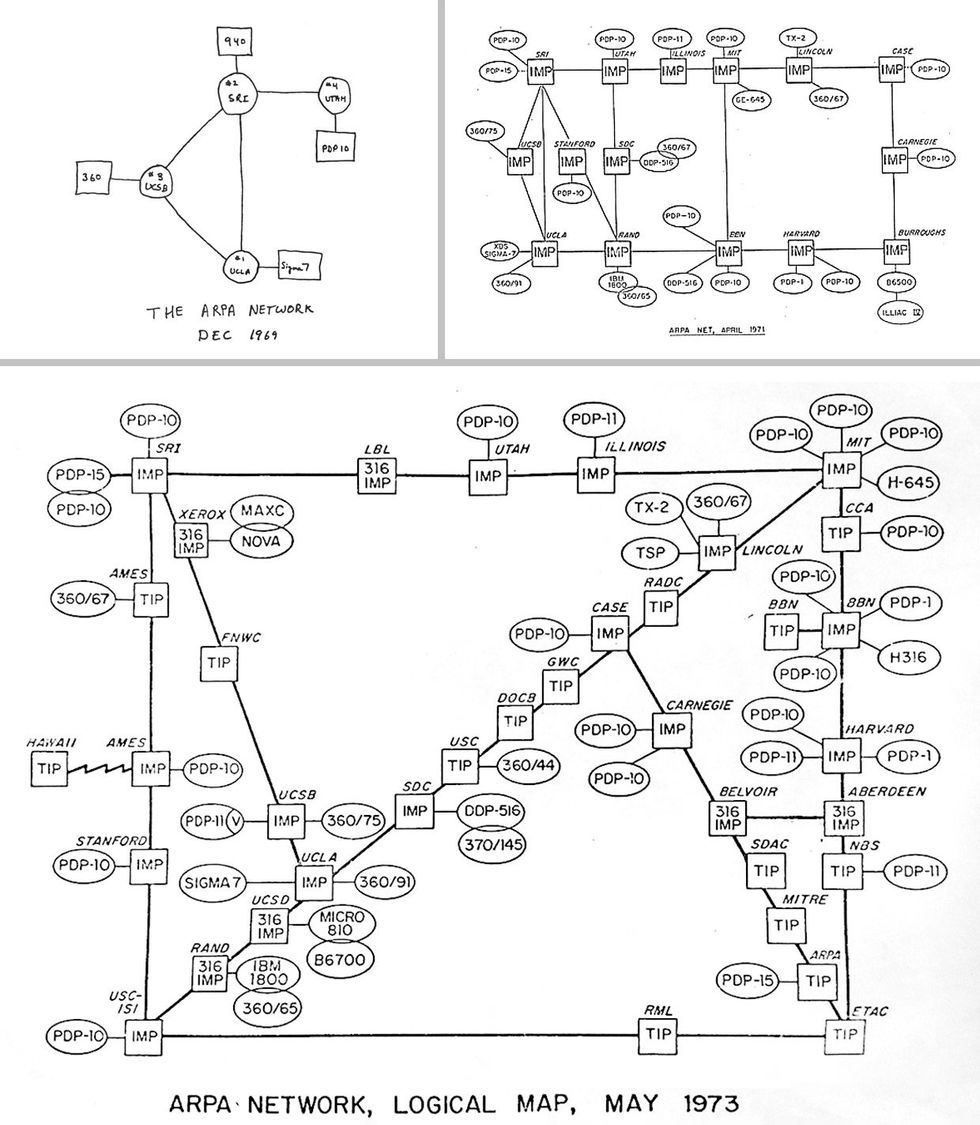 As these hand drawings from the time present, in December 1969 the ARPANET had simply 4 nodes [top left]. That quantity grew to fifteen by April 1971 [top right]. In an effort to hurry the enlargement additional, community advocates organized an illustration on the Worldwide Convention on Pc Communications in Washington, D.C., in October 1972. That assembly helped to develop the ARPANET, which by Might of 1973 included some three dozen nodes [bottom].Pc Historical past Museum
For this to work easily, Kahn organized for numerous functions (referred to as “situations”) to be created and examined. He additionally needed to persuade producers to mortgage, set up, and configure terminals. And he needed to work with the lodge to arrange the room for the demo and prepare with
AT&T to run leased traces to the Hilton’s ballroom.
The ICCC would show to be for packet switching what the
1876 Centennial Exposition in Philadelphia was for the phone: the general public unveiling of what would ultimately result in a technological discontinuity.
For the tons of of computer-communications professionals, authorities staff, and educational researchers attending the ICCC, the demo completely modified their perceptions of a pc as a single machine locked in an air-conditioned room. The TIP was on a raised flooring in the course of the ballroom, with dozens of related laptop terminals circled round it and dozens of ARPA scientists milling about, keen to indicate off their satisfaction and pleasure.
To take a seat at a terminal and with just a few keystrokes be related by way of the TIP, to the ARPANET, after which to functions working on computer systems at dozens of universities and analysis amenities should have felt like a go to to an alien world. And for the ARPA scientists concerned, the bonds shaped from staging the demonstration left them heady and optimistic concerning the future they have been creating.
Assume Globally. Act Regionally
Researchers in authorities, academia, and business struggled over the following a number of years to appreciate the potential of what that they had seen. How might they scale up and simplify the capabilities that Kahn and firm spent a yr bringing to the Hilton ballroom? One main drawback was the associated fee and fragility of stringing a devoted cable from each laptop to each terminal. A number of events converged on an analogous answer: an area space community, the place one “native” cable might traverse a whole facility with all terminals and computer systems related to it.
Customers in massive organizations—together with the U.S. Air Drive, which had many years of expertise and investments in laptop communications—had probably the most to achieve from options to those issues. To advertise cooperation,
Robert Rosenthal on the U.S. Nationwide Bureau of Requirements and Norman Meisner at Mitre, a federally funded R&D group, organized a collection of workshops in early 1979 to discover “Native Space Community Protocols.” Their objective was to supply a mechanism for sharing and acquiring outcomes from the newest analysis—particularly information that was not obtainable within the revealed literature. When Rosenthal and Meisner contacted potential individuals, it turned clear that whereas just about everybody engaged on native space networking sensed its significance, all of them expressed confusion over what to do about it.
When it got here to checking out the answer, a gathering Rosenthal and Meisner organized in Might 1979 proved to have enduring significance. The Native Space Communications Community Symposium, held on the Copley Plaza Resort in Boston, featured 5 formal classes, panel discussions, and twelve workshops. Rosenthal was astonished when about 400 folks confirmed up. For many, it was a formative occasion, comparable in significance to the ARPANET demonstration in 1972. “There was electrical energy within the air,” Rosenthal recalled in a
1988 interview with one among us (Pelkey). “You had leaders [like] Bob Metcalfe saying: ‘The world’s going to be a greater place.’ ”
Bruce Hunt of Zilog remembers “being amazed at how many individuals have been actually enthusiastic about native space networks,” and feeling happy that the intuition of the researchers concerned—that they have been onto one thing actually essential—was validated. And it wasn’t simply hype by teachers: Inside a few months, three new firms have been shaped—Sytek, 3Com, and Ungermann-Bass. Emboldened by the clear demand for industrial networking tools, these startups raised tens of millions from buyers and instantly started promoting merchandise for native space networking.
Increasingly professionals got here to appreciate that networking expertise would generate essential advantages. However the engineers concerned had not settled many technical particulars about how these networks would work. And a rising variety of alternate options quickly can be thought of for standardization by the IEEE, together with a now well-known expertise referred to as Ethernet, which can have a good time the fiftieth anniversary of its standardization in Might of this yr.
Beginning of OSI
Within the meantime, work was underway on a broader method to the problem of making requirements for laptop communication
—one that might serve to hyperlink up completely different laptop networks, an idea that started right now to be referred to as “internetworking.” In 1978, just a few dozen consultants from all over the world held the primary assembly for an bold mission to create a complete suite of requirements and protocols for disparate networking applied sciences. This effort, often known as Open Programs Interconnection (OSI), was hosted first by the Worldwide Group for Standardization (ISO) and later, collectively, by ISO and the Worldwide Telecommunication Union. OSI’s founding premise was {that a} layered structure would supply a approach to pull collectively the requirements, functions, and companies that numerous teams all over the world have been growing.
The decrease layers of OSI involved the formatting, encoding, and transmission of knowledge over networks. The higher layers included superior capabilities and functions, equivalent to electronic message and listing companies.
A number of initiatives examined proposals for requirements and functions inside OSI’s seven-layer framework. One arose at
Normal Motors, which had a strategic objective of utilizing computer-based automation to fight rising competitors from overseas. In 1981, GM held exploratory conversations with Digital Gear Corp., Hewlett-Packard, and IBM. These discussions culminated within the launch of GM’s Manufacturing Automation Protocol (MAP) model 1.0 in 1982.
Boeing, with comparable objectives, introduced that it could work with the Nationwide Bureau of Requirements to guide the creation of an OSI protocol stack for technical and workplace environments, later to be named Technical and Workplace Protocols (TOP).
As soon as once more, potential customers and prospects sought out dwell demonstrations in order that they may decide for themselves what was hype and what was actuality. One extremely anticipated demo befell at Autofact ’85, a convention whose title displays the period’s deep preoccupation with manufacturing unit automation.
Autofact ’85 drew about 30,000 folks to Detroit, with some 200 distributors exhibiting MAP-compatible and different kinds of automation merchandise. Along with data-processing tools equivalent to computer systems and terminals, a wide range of factory-automation techniques, together with robots, imaginative and prescient techniques, and engineering workstations, have been on show. With them, attendees explored a custom-designed model of the Towers of Hanoi recreation, and an software for interactive file switch, entry, and administration.
Though Autofact ’85 was effectively attended and customarily hailed within the commerce press as successful, some have been postpone by its deal with issues to come back. As one press account put it, “On the present flooring, there are many demonstrations however few obtainable merchandise.” The lingering questions round precise industrial functions gave promoters purpose to proceed organizing public demonstrations, such because the Enterprise Networking Occasion (ENE) in Baltimore, in June 1988.
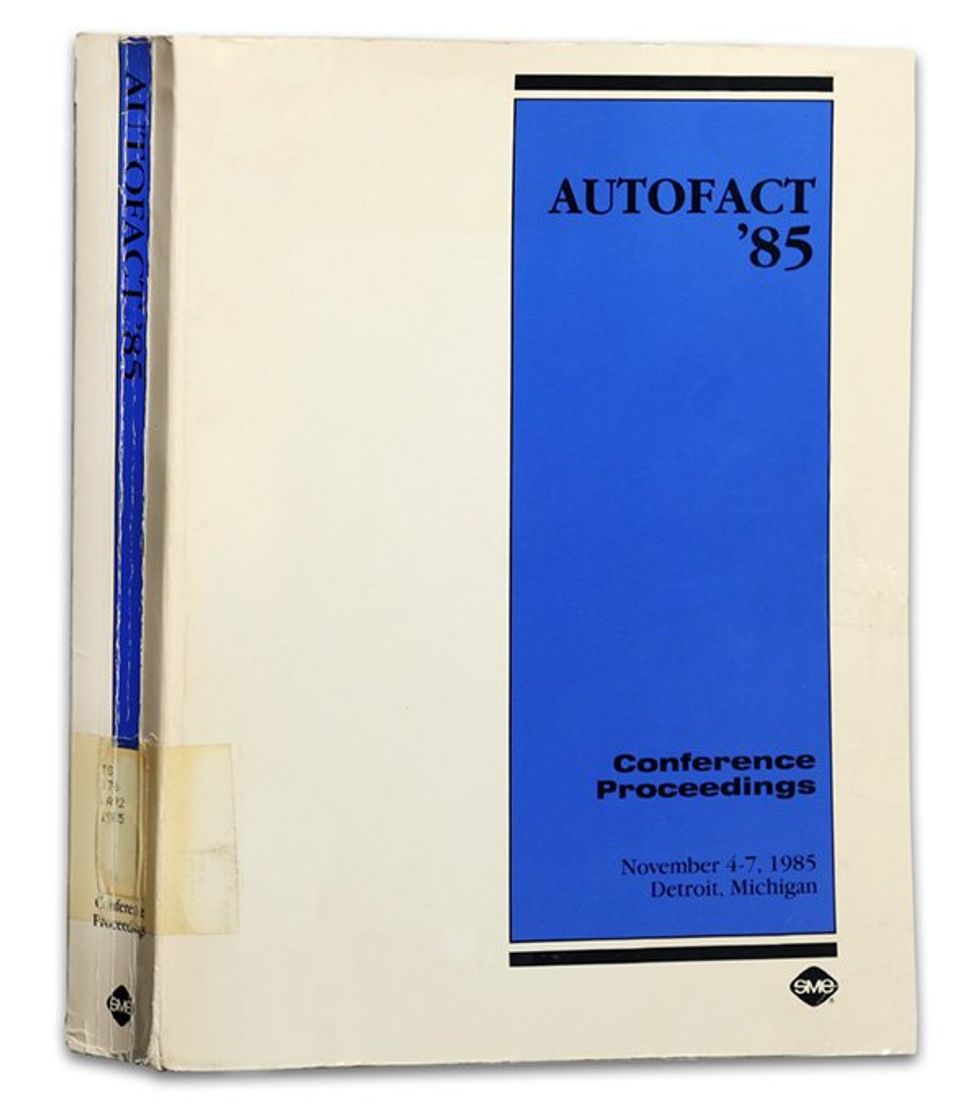 Autofact ’85, a convention whose title displays folks’s eager curiosity in manufacturing unit automation throughout that point, led to 30,000 folks and 200 distributors to Detroit in November of 1985. SUNY Polytechnic Institute
The hope for ENE was to supply demos in addition to showcase merchandise that have been really obtainable for buy. All of the U.S. computing giants—together with IBM, HP, AT&T,
Xerox, Information Normal, Wang Laboratories, and Honeywell—can be there, in addition to main European producers and a few smaller and youthful firms with OSI-compatible merchandise, equivalent to Apple, Micom, Retix, Solar Microsystems, 3Com, and Contact Communications. Keynote audio system from the higher ranges of the U.S. Division of Protection, Arthur Andersen, and the Fee of European Communities bolstered the message that every one main stakeholders have been behind the worldwide adoption of OSI.
ENE confirmed each the hopes of OSI’s supporters and the fears of its critics. Distributors have been in a position to exhibit OSI requirements for community administration and electronic message, however as an alternative of merchandise on the market, the ten,000 or so attendees noticed largely demonstrations of prototypes—a marginal enchancment on Autofact ’85.
The Web Cometh
There was a painful actuality to the pc networks of the mid-Nineteen Eighties: On the one hand, they held an unlimited potential to enhance enterprise practices and improve productiveness; on the opposite, precise merchandise that might combine the range of put in tools and networks—and thus present a sturdy technique of internetworking—have been very restricted. The sluggish progress of MAP and TOP merchandise left a gap for different approaches.
And probably the most promising of these approaches was to depend on the core protocols then in use for the ARPANET: Transmission Management Protocol and Web Protocol (identified to insiders as
TCP/IP). A broad marketplace for appropriate tools hadn’t but developed, however the neighborhood of consultants that had grown across the ARPANET was more and more energetic in selling the industrial adoption of such merchandise.
One of many chief promoters was
Dan Lynch, a marketing consultant who was instrumental in managing the ARPANET’s transition to TCP in 1983. Lynch led the planning of a workshop in Monterey, Calif., in August 1986, the place tools distributors might study TCP/IP. Lynch needed to get the apostles of TCP “to come back out of their ivory towers” and supply some steering for distributors implementing their protocols. And so they did, as Lynch recalled in a 1988 interview, the place he referred to as the workshop “outrageously profitable.”
This assembly, the primary TCP/IP Distributors Workshop, featured a mixture of leaders from the TCP/IP analysis neighborhood and representatives from 65 distributors, equivalent to Ungermann-Bass and
Excelan. Lynch continued this trade-show-like method with the TCP/IP Interoperability Convention in Monterey in March 1987 and the 2nd TCP/IP Interoperability Convention in Arlington, Va., in December of the identical yr.
Lynch’s technique for TCP/IP gave the impression to be gaining momentum, as evidenced by an article in
Information Communications in November 1987, which neatly summarized the state of affairs: “By the tip of 1986, there have been greater than 100 vendor choices of TCP/IP and its related DARPA protocols. Furthermore, main distributors, together with IBM and Digital Gear Corp. have just lately begun to supply TCP/IP as a part of their product traces…. Whereas the long-term strategic route taken by most firms is within the implementation of the OSI mannequin and its protocols, TCP/IP seems to be fixing the short-term issues of connections between networks.”
The market-research agency
Infonetics revealed a report in Might 1988 that documented a “dramatic enhance within the commercialization of TCP/IP” and famous that rising numbers of customers have been looking for options to combine numerous laptop tools and networks. “Each sector of the market is planning to buy TCP/IP merchandise within the subsequent yr,” the report acknowledged. “There is no such thing as a indication that OSI is affecting buy intent.”
Get Prepared for the World Extensive Internet
On the time, Lynch was planning a brand new venue to advertise the adoption of the protocols used for the ARPANET: the TCP/IP Interoperability Exhibition and Options Showcase, to be held in Santa Clara, Calif., in September 1988. And he gave the occasion a slick new title: Interop.
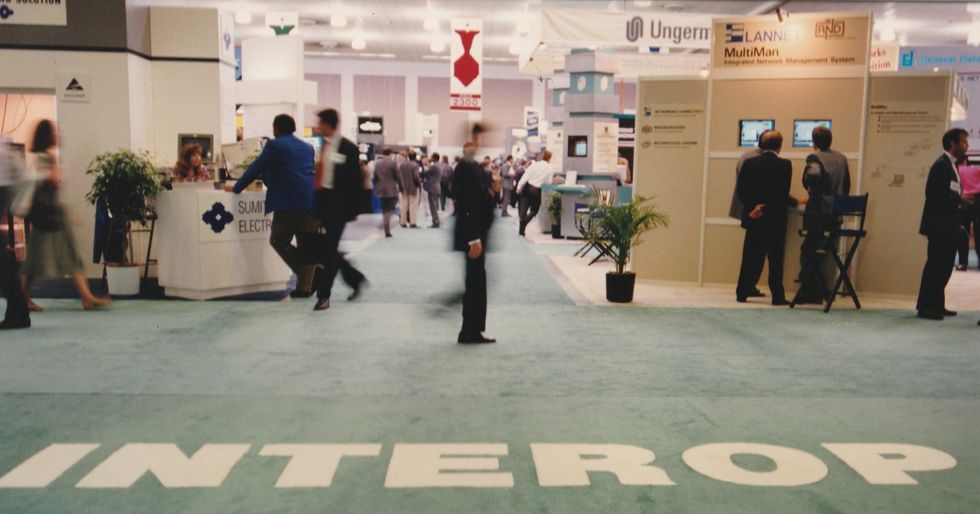 One of many key business conferences that helped form the Web was the 1988 TCP/IP Interoperability Exhibition and Options Showcase in Santa Clara, Calif., which was given the shorter, catchier title “Interop.” Margot Simmons
Interop featured plenty of merchandise: “each medium, each bridge field, each router you possibly can think about,” based on Peter de Vries of the Wollongong Group, which was accountable for placing collectively the community at Interop. That community supplied connections amongst all distributors on show, together with tools obtainable for buy from
Cisco Programs, Proteon, and Wellfleet Communications.
Utilizing TCP/IP, attendees might traverse hyperlinks to
NSFNET, the regional BARRNET in San Francisco, and a wide range of different networks. Distributors might take part in TCP/IP “bake-offs,” the place they may verify to see whether or not their tools interoperated with different distributors’ merchandise. Self-appointed “internet police” went as far as handy out “tickets” to implementations that didn’t adjust to the TCP/IP specs.
In lots of respects, Interop ’88 was much more profitable than ENE. It featured working merchandise from extra distributors than did ENE. And whereas ENE carried the burden of individuals’s expectations that it could present complete options for large-scale manufacturing, workplace, and authorities procurement, Interop took on the fast and narrower issues of community interconnection. Within the “age of requirements,” as an article in
Information Communications referred to that point, this deal with product compatibility, interoperability, and connectivity energized the estimated 5,000 attendees in addition to the marketplace for TCP/IP merchandise.
The stage was now set for improvements that will change international society:
the invention of the World Extensive Internet the next yr and the privatization of the NSFNET/Web spine within the mid-Nineties. The advances in international laptop networking which have come since then all relaxation on that preliminary basis.
Accounts of the beginnings of contemporary computing usually embrace dramatic descriptions of a convention that has since change into often known as “the
Mom of all Demos”—a 1968 joint assembly of the Affiliation for Computing Equipment and the IEEE Pc Society the place ARPA-funded researcher Douglas Engelbart gave a 90-minute presentation that included the usage of home windows, hypertext, videoconferencing, and the pc mouse, amongst different improvements. His demo is rightly acknowledged as a turning level for increasing the realm of the potential in private computing. However mind-expanding potentialities have been additionally on show—and generally even on the market—on the 5 conferences we’ve described right here. In our view, the contribution of those business occasions to the event of right now’s world of computing shouldn’t be forgotten, as a result of the connection of various sorts of computer systems is the advance that has reworked our lives.
Loring Robbins and Andrew Russell dedicate this text to their coauthor and longtime buddy James Pelkey, who died shortly earlier than it was revealed.
From Your Website Articles
Associated Articles Across the Internet
[ad_2]

