


[ad_1]
As Verne understood, the U.S. Civil Struggle (throughout which
60,000 amputations have been carried out) inaugurated the trendy prosthetics period in the US, because of federal funding and a wave of design patents filed by entrepreneurial prosthetists. The 2 World Wars solidified the for-profit prosthetics business in each the US and Western Europe, and the continuing Struggle on Terror helped catapult it right into a US $6 billion greenback business throughout the globe. This latest funding shouldn’t be, nevertheless, a results of a disproportionately massive variety of amputations in navy battle: Round 1,500 U.S. troopers and 300 British troopers misplaced limbs in Iraq and Afghanistan. Limb loss within the common inhabitants dwarfs these figures. In the US alone, greater than 2 million individuals dwell with limb loss, with 185,000 individuals receiving amputations yearly. A a lot smaller subset—between 1,500 to 4,500 kids annually—are born with limb variations or absences, myself included.
Right now, the individuals who design prostheses are usually well-intentioned engineers somewhat than amputees themselves. The fleshy stumps of the world act as repositories for these designers’ goals of a high-tech, superhuman future. I do know this as a result of all through my life I’ve been fitted with a few of the most
cutting-edge prosthetic gadgets in the marketplace. After being born lacking my left forearm, I used to be one of many first cohorts of infants in the US to be fitted with a myoelectric prosthetic hand, an digital system managed by the wearer’s muscle mass tensing in opposition to sensors contained in the prosthetic socket. Since then, I’ve donned quite a lot of prosthetic arms, every of them striving towards excellent constancy of the human hand—generally at a price of aesthetics, generally a price of performance, however all the time designed to imitate and exchange what was lacking.
In my lifetime, myoelectric arms have advanced from clawlike constructs to multigrip, programmable, anatomically correct facsimiles of the human hand, most costing tens of hundreds of {dollars}. Reporters can’t get sufficient of those refined, multigrasping “bionic” arms with lifelike silicone skins and natural actions, the unstated promise being that incapacity will quickly vanish and any misplaced limb or organ will likely be changed with an equally succesful duplicate. Prosthetic-hand innovation is handled like a high-stakes competitors to see what’s technologically doable. Tyler Hayes, CEO of the prosthetics startup
Atom Limbs, put it this manner in a WeFunder video that helped increase $7.2 million from traders: “Each moonshot in historical past has began with a good quantity of loopy in it, from electrical energy to area journey, and Atom Limbs is not any completely different.”
We’re caught in a bionic-hand arms race. However are we making actual progress? It’s time to ask who prostheses are actually for, and what we hope they are going to truly accomplish. Every new multigrasping bionic hand tends to be extra refined but in addition dearer than the final and fewer prone to be coated (even partly) by insurance coverage. And as latest analysis concludes, a lot less complicated and much cheaper prosthetic gadgets can carry out many duties equally nicely, and the flowery bionic arms, regardless of all of their digital choices, are not often used for greedy.
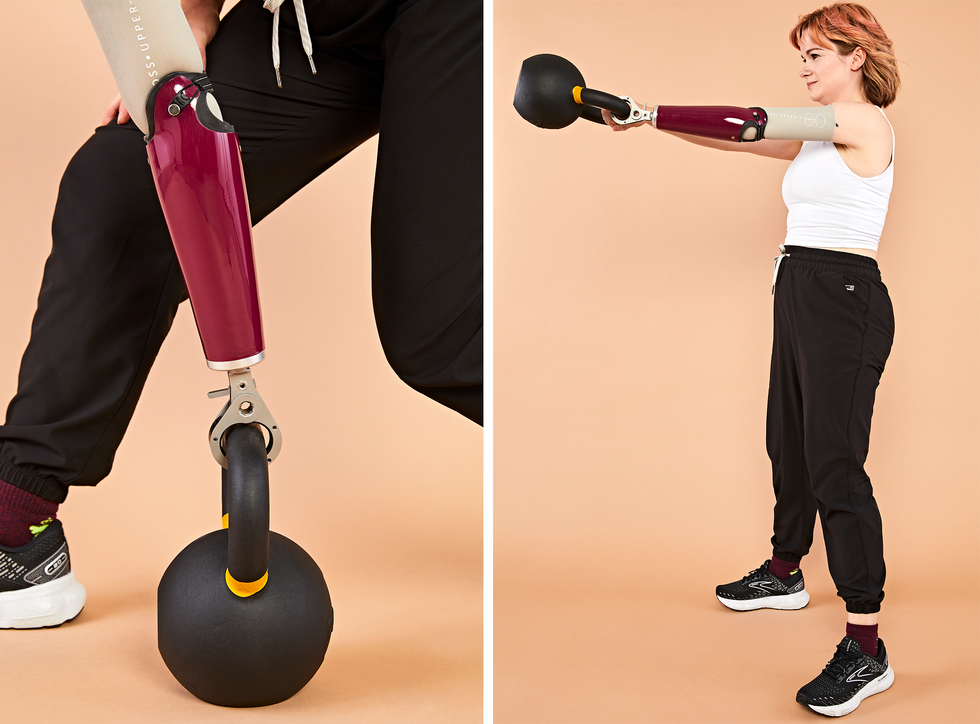 Exercise arms, resembling this one manufactured by prosthetics agency Arm Dynamics, are cheaper and extra sturdy than bionic prostheses. The attachment from prosthetic-device firm Texas Assistive Units rated for very heavy weights, permitting the creator to carry out workouts that might be dangerous or unimaginable along with her far more costly bebionic arm.Gabriela Hasbun; Make-up: Maria Nguyen for MAC cosmetics; Hair: Joan Laqui for Dwelling Proof
Perform or Type
In latest a long time, the overwhelming focus of analysis into and improvement of latest synthetic arms has been on perfecting various kinds of grasps. Most of the most costly arms in the marketplace differentiate themselves by the quantity and number of selectable prehensile grips. My very own media darling of a hand, the bebionic from Ottobock, which I obtained in 2018, has a fist-shaped energy grip, pinching grips, and one very particular mode with thumb on high of index finger for politely handing over a bank card. My Twenty first-century myoelectric hand appeared exceptional—till I attempted utilizing it for some routine duties, the place it proved to be
extra cumbersome and time consuming than if I had merely left it on the sofa. I couldn’t use it to tug a door shut, for instance, a process I can do with my stump. And with out the extraordinarily costly addition of a powered wrist, I couldn’t pour oatmeal from a pot right into a bowl. Performing duties the cool bionic means, although it mimicked having two arms, wasn’t clearly higher than doing issues my means, generally with the assistance of my legs and ft.
After I first spoke with
Advert Spiers, lecturer in robotics and machine studying at Imperial School London, it was late at night time in his workplace, however he was nonetheless animated about robotic arms—the present focus of his analysis. Spiers says the anthropomorphic robotic hand is inescapable, from the truth of in the present day’s prosthetics to the fantasy of sci-fi and anime. “In one in every of my first lectures right here, I confirmed clips of flicks and cartoons and the way cool filmmakers make robotic arms look,” Spiers says. “Within the anime Gundam, there are such a lot of close-ups of gigantic robotic arms grabbing issues like large weapons. However why does it have to be a human hand? Why doesn’t the robotic simply have a gun for a hand?”
It’s time to ask who prostheses are actually for, and what we hope they are going to truly accomplish.
Spiers believes that prosthetic builders are too caught up in kind over perform. However he has talked to sufficient of them to know they don’t share his viewpoint: “I get the sensation that individuals love the concept of people being nice, and that arms are what make people fairly distinctive.” Practically each college robotics division Spiers visits has an anthropomorphic robotic hand in improvement. “That is what the longer term seems to be like,” he says, and he sounds just a little exasperated. “However there are sometimes higher methods.”
The overwhelming majority of people that use a prosthetic limb are unilateral amputees—individuals with amputations that have an effect on just one aspect of the physique—they usually nearly all the time use their dominant “fleshy” hand for delicate duties resembling choosing up a cup. Each unilateral and bilateral amputees additionally get assist from their torsos, their ft, and different objects of their setting; not often are duties carried out by a prosthesis alone. And but, the widespread scientific evaluations to find out the success of a prosthetic are based mostly on utilizing solely the prosthetic, with out the assistance of different physique components. Such evaluations appear designed to show what the prosthetic hand can do somewhat than to find out how helpful it truly is within the each day lifetime of its consumer. Disabled persons are nonetheless not the arbiters of prosthetic requirements; we’re nonetheless not on the coronary heart of design.
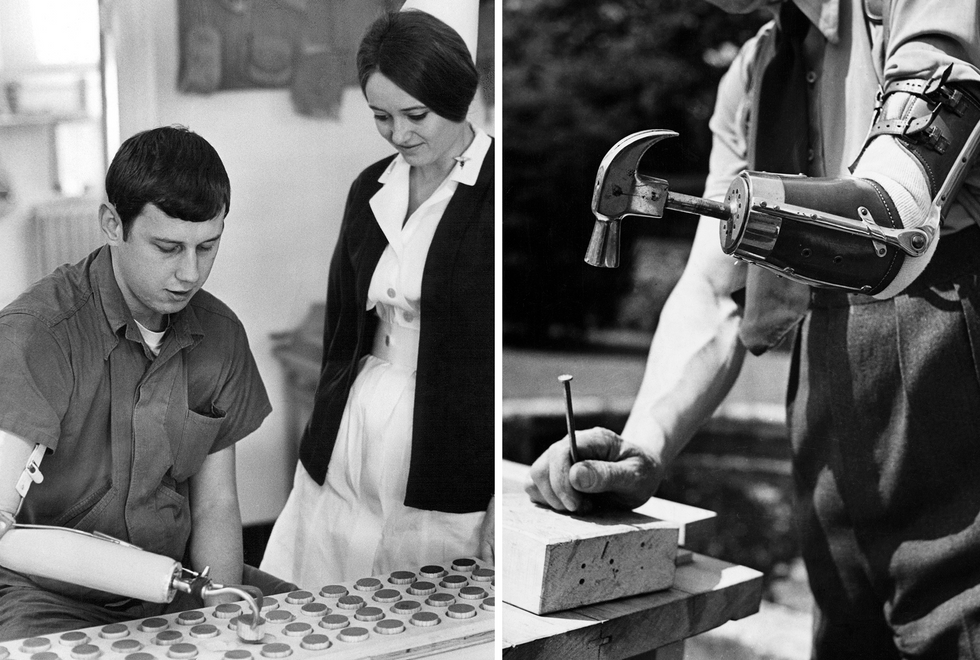 The Hosmer Hook [left], initially designed in 1920, is the terminal system on a body-powered design that’s nonetheless used in the present day. A hammer attachment [right] could also be more practical than a gripping attachment when hammering nails into wooden.Left: John Prieto/The Denver Submit/Getty Photos; Proper: Hulton-Deutsch Assortment/Corbis/Getty Photos
Prosthetics within the Actual World
To learn how prosthetic customers dwell with their gadgets,
Spiers led a research that used cameras worn on individuals’ heads to file the each day actions of eight individuals with unilateral amputations or congenital limb variations. The research, printed final yr in IEEE Transactions on Medical Robotics and Bionics, included a number of styles of myoelectric arms in addition to body-powered techniques, which use actions of the shoulder, chest, and higher arm transferred via a cable to mechanically function a gripper on the finish of a prosthesis. The analysis was performed whereas Spiers was a analysis scientist at Yale College’s GRAB Lab, headed by Aaron Greenback. Along with Greenback, he labored carefully with grad scholar Jillian Cochran, who coauthored the research.
Watching uncooked footage from the research, I felt each disappointment and camaraderie with the nameless prosthesis customers. The clips present the clumsiness, miscalculations, and unintentional drops which can be acquainted to even very skilled prosthetic-hand customers. Usually, the prosthesis merely helps brace an object in opposition to the physique to be dealt with by the opposite hand. Additionally obvious was how a lot time individuals spent making ready their myoelectric prostheses to hold out a process—it continuously took a number of further seconds to manually or electronically rotate the wrists of their gadgets, line up the thing to seize it excellent, and work out the grip method.The participant who hung a bottle of disinfectant spray on their “hook” hand whereas wiping down a kitchen counter gave the impression to be the one who had all of it found out.
Within the research, prosthetic gadgets have been used on common for less than 19 % of all recorded manipulations. On the whole, prostheses have been employed in largely nonprehensile actions, with the opposite, “intact” hand doing many of the greedy. The research highlighted massive variations in utilization between these with nonelectric, body-powered prosthetics and people with myoelectric prosthetics. For body-powered prosthetic customers whose amputation was under the elbow, practically 80 % of prosthesis utilization was nongrasping motion—pushing, urgent, pulling, hanging, and stabilizing. For myoelectric customers, the system was used for greedy simply 40 % of the time.
Extra tellingly, body-powered customers with nonelectric grippers or break up hooks spent considerably much less time performing duties than did customers with extra advanced prosthetic gadgets. Spiers and his staff famous the fluidity and velocity with which the previous went about doing duties of their properties. They have been ready to make use of their synthetic arms nearly instantaneously and even expertise direct haptic suggestions via the cable that drives such techniques. The analysis additionally revealed little distinction in use between myoelectric single-grasp gadgets and fancier myoelectric multiarticulated, multigrasp arms—besides that customers tended to keep away from hanging objects from their multigrasp arms, seemingly out of worry of breaking them.
“We bought the sensation that individuals with multigrasp myoelectric arms have been fairly tentative about their use,” says Spiers. It’s no marvel, since most myoelectric arms are priced over $20,000, are not often accredited by insurance coverage, require frequent skilled assist to vary grip patterns and different settings, and have expensive and protracted restore processes. As prosthetic applied sciences develop into extra advanced and proprietary, the long-term serviceability is an growing concern. Ideally, the system must be simply fixable by the consumer. And but some prosthetic startups are pitching a subscription mannequin, during which customers proceed to pay for entry to repairs and assist.
Regardless of the conclusions of his research, Spiers says the overwhelming majority of prosthetics R&D stays targeted on refining the greedy modes of high-priced, high-tech bionic arms. Even past prosthetics, he says, manipulation research in nonhuman primate analysis and robotics are overwhelmingly involved with greedy: “Something that isn’t greedy is simply thrown away.”
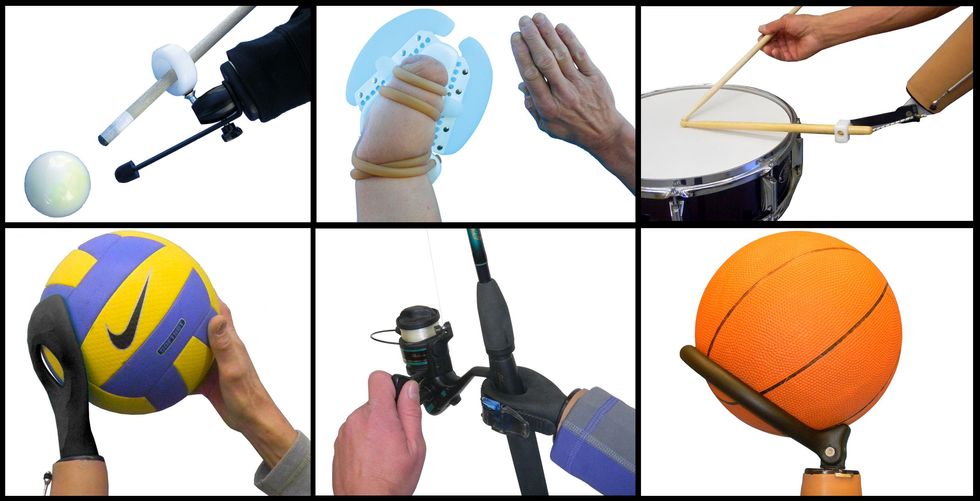 TRS makes all kinds of body-powered prosthetic attachments for various hobbies and sports activities. Every attachment is specialised for a specific process, and they are often simply swapped for quite a lot of actions. Fillauer TRS
Greedy at Historical past
If we’ve determined that what makes us human is our arms, and what makes the hand distinctive is its capacity to understand, then the one prosthetic blueprint we have now is the one hooked up to most individuals’s wrists. But the pursuit of the last word five-digit grasp isn’t essentially the logical subsequent step. In actual fact, historical past suggests that individuals haven’t all the time been fixated on completely re-creating the human hand.
As recounted within the 2001 essay assortment
Writing on Fingers: Reminiscence and Information in Early Trendy Europe, concepts concerning the hand advanced over the centuries. “The soul is just like the hand; for the hand is the instrument of devices,” Aristotle wrote in De Anima. He reasoned that humanity was intentionally endowed with the agile and prehensile hand as a result of solely our uniquely clever brains may make use of it—not as a mere utensil however a instrument for apprehensio, or “greedy,” the world, actually and figuratively.
Greater than 1,000 years later, Aristotle’s concepts resonated with artists and thinkers of the Renaissance. For Leonardo da Vinci, the hand was the mind’s mediator with the world, and he went to distinctive lengths in his dissections and illustrations of the human hand to know its principal elements. His meticulous research of the tendons and muscle mass of the forearm and hand led him to conclude that “though human ingenuity makes varied innovations…it would by no means uncover innovations extra stunning, extra becoming or extra direct than nature, as a result of in her innovations nothing is missing and nothing is superfluous.”
Da Vinci’s illustrations precipitated a wave of curiosity in human anatomy. But for the entire studious rendering of the human hand by European masters, the hand was regarded extra as an inspiration than as an object to be replicated by mere mortals. In actual fact, it was broadly accepted that the intricacies of the human hand evidenced divine design. No machine, declared the Christian thinker William Paley, is “extra synthetic, or extra evidently so” than the flexors of the hand, suggesting deliberate design by God.
Performing duties the cool bionic means, although it mimicked having two arms, wasn’t clearly higher than doing issues my means, generally with the assistance of my legs and ft.
By the mid-1700s, with the Industrial Revolution within the world north, a extra mechanistic view of the world started to emerge, and the road between dwelling issues and machines started to blur. In her 2003 article “
Eighteenth-Century Wetware,” Jessica Riskin, professor of historical past at Stanford College, writes, “The interval between the 1730s and the 1790s was one in every of simulation, during which mechanicians tried earnestly to break down the hole between animate and synthetic equipment.” This era noticed vital modifications within the design of prosthetic limbs. Whereas mechanical prostheses of the sixteenth century have been weighed down with iron and is derived, a 1732 body-powered prosthesis used a pulley system to flex a hand made from light-weight copper. By the late 18th century, metallic was being changed with leather-based, parchment, and cork—softer supplies that mimicked the stuff of life.
The techno-optimism of the early twentieth century caused one other change in prosthetic design, says
Wolf Schweitzer, a forensic pathologist on the Zurich Institute of Forensic Drugs and an amputee. He owns all kinds of up to date prosthetic arms and has the required expertise to check them. He notes that anatomically appropriate prosthetic arms have been carved and cast for the higher a part of 2,000 years. And but, he says, the twentieth century’s body-powered break up hook is “extra trendy,” its design extra keen to interrupt the mildew of the human hand.
“The physique powered arm—when it comes to its symbolism—(nonetheless) expresses the man-machine symbolism of an industrial society of the Nineteen Twenties,”
writes Schweitzer in his prosthetic arm weblog, “when man was to perform as clockwork cogwheel on manufacturing traces or in agriculture.” Within the unique Nineteen Twenties design of the Hosmer Hook, a loop contained in the hook was positioned only for tying sneakers and one other only for holding cigarettes. These designs, Advert Spiers informed me, have been “extremely practical, perform over kind. All items served a particular goal.”
Schweitzer believes that as the necessity for guide labor decreased over the twentieth century, prostheses that have been high-functioning however not naturalistic have been eclipsed by a brand new high-tech imaginative and prescient of the longer term: “bionic” arms. In 2006, the U.S. Protection Superior Analysis Initiatives Company launched
Revolutionizing Prosthetics, a analysis initiative to develop the subsequent technology of prosthetic arms with “near-natural” management. The $100 million program produced two multi-articulating prosthetic arms (one for analysis and one other that prices over $50,000). Extra importantly, it influenced the creation of different related prosthetics, establishing the bionic hand—because the navy imagined it—because the holy grail in prosthetics. Right now, the multigrasp bionic hand is hegemonic, an emblem of cyborg wholeness.
And but some prosthetic builders are pursuing a distinct imaginative and prescient. TRS, based mostly in Boulder, Colo., is among the few producers of
activity-specific prosthetic attachments, which are sometimes extra sturdy and extra financially accessible than robotic prosthetics. These plastic and silicone attachments, which embody a squishy mushroom-shaped system for push-ups, a ratcheting clamp for lifting heavy weights, and a concave fin for swimming, have helped me expertise the best performance I’ve ever gotten out of a prosthetic arm.
Such low-tech exercise prostheses and body-powered prostheses carry out astonishingly nicely, for a tiny fraction of the price of bionic arms. They don’t look or act like human arms, they usually perform all the higher for it. In keeping with Schweitzer, body-powered prostheses are
usually dismissed by engineers as “arcane” or derisively referred to as “Captain Hook.” Future bionic shoulders and elbows could make an enormous distinction within the lives of individuals lacking a limb as much as their shoulder, assuming these gadgets may be made strong and reasonably priced. However for Schweitzer and a big proportion of customers dissatisfied with their myoelectric prosthesis, the prosthetic business has but to supply something basically higher or cheaper than body-powered prostheses.
The Breakthroughs We Need
Bionic arms search to make disabled individuals “entire,” to have us take part in a world that’s culturally two-handed. Nevertheless it’s extra vital that we get to dwell the lives we wish, with entry to the instruments we’d like, than it’s to make us appear like everybody else. Whereas many limb-different individuals have used bionic arms to work together with the world and categorical themselves, the centuries-long effort to excellent the bionic hand not often facilities on our lived experiences and what we wish to do in our lives.
We’ve been promised a breakthrough in prosthetic know-how for the higher a part of 100 years now. I’m reminded of the scientific pleasure round lab-grown meat, which appears concurrently like an explosive shift and an indication of mental capitulation, during which political and cultural change is handed over in favor of a technological repair. With the forged of characters on the earth of prosthetics—medical doctors, insurance coverage firms, engineers, prosthetists, and the navy—enjoying the identical roles they’ve for many years, it’s practically unimaginable to provide one thing actually revolutionary.
Within the meantime, this metaphorical race to the moon is a mission that has forgotten its unique concern: serving to disabled individuals purchase and use the instruments they need. There are cheap, accessible, low-tech prosthetics which can be out there proper now and that want investments in innovation to additional deliver down prices and enhance performance. And in the US at the least, there’s a damaged insurance coverage system that wants fixing. Releasing ourselves from the bionic-hand arms race can open up the probabilities of extra practical designs which can be extra helpful and reasonably priced, and would possibly assist us deliver our prosthetic aspirations again all the way down to earth.
This text seems within the October 2022 print challenge.
[ad_2]

