


[ad_1]
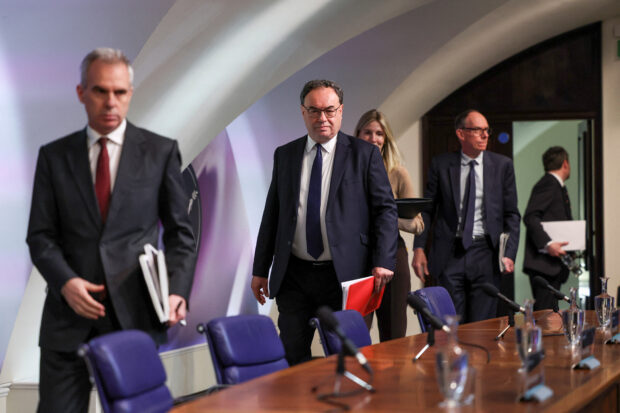
Financial institution of England’s Deputy Governor, Financial Coverage Ben Broadbent, Governor Andrew Bailey, Head of Media and Stakeholder Engagement Katie Martin and Deputy Governor, Markets and Banking Dave Ramsden attend a press convention on the Financial institution of England, London, Britain, Could 11, 2023. REUTERS/Henry Nicholls/Pool
LONDON -The Financial institution of England raised its key rate of interest by 1 / 4 of a proportion level to 4.5 % on Thursday and Governor Andrew Bailey mentioned the British central financial institution would “keep the course” because it seeks to curb the quickest inflation of any main financial system.
The central financial institution is now not predicting a recession after it revised up progress forecasts from the gloomy projections it launched in February, the largest such enchancment because it first printed forecasts in 1997.
However it additionally now expects inflation – which remained above 10% in March – to be slower to fall than it had hoped, principally attributable to unexpectedly huge and protracted rises in meals costs. It additionally noticed stronger wage progress than it beforehand thought.
“Now we have to remain the course to verify inflation falls all the way in which again to the 2- % goal,” Bailey mentioned in a press release at first of a press convention.
A Reuters ballot final week confirmed most economists anticipated a quarter-point rise in Could – taking borrowing prices to their highest since 2008 with its twelfth consecutive price rise – and for the BoE to maintain charges on maintain after that.
However traders have been betting on additional will increase in Financial institution Fee and shortly after Thursday’s determination, rate of interest futures had been pricing in a 5-percent peak for charges this autumn.
“If there have been to be proof of extra persistent pressures, then additional tightening in financial coverage can be required,” the BoE mentioned, retaining the identical steering on future actions that it had in February and March.
The pound rose nearly half a cent in opposition to the U.S. greenback, topping $1.26, whereas British authorities bond yields jumped in response to the BoE’s transfer.
“Inflation knowledge will probably be watched extraordinarily intently over the following few months and could also be a supply of market volatility particularly round foreign money, with sterling now pricing in additional aggressive motion from the BoE from right here in comparison with different central financial institutions,” abrdn senior economist Luke Bartholomew mentioned.
Policymakers voted 7-2 for Could’s improve, consistent with economists’ expectations within the Reuters ballot as Financial Coverage Committee members Silvana Tenreyro and Swati Dhingra once more expressed their opposition to additional tightening.
The BoE was the primary main central financial institution to begin elevating borrowing prices in December 2021, but it surely has been accused by critics of not transferring aggressively sufficient as inflation headed in direction of a four-decade excessive of 11.1 % struck in October.
Final week, the U.S. Federal Reserve and the European Central Financial institution each raised their benchmark borrowing charges by 25 foundation factors. Whereas Fed Chair Jerome Powell hinted at a pause, ECB President Christine Lagarde mentioned it was too quickly to cease.
Britain’s excessive inflation downside stems largely from its heavy dependence on imported pure gasoline for energy technology, leaving it notably uncovered to the surge in power costs after Russia’s invasion of Ukraine final 12 months.
Vitality costs have now fallen sharply and the central financial institution expects inflation to drop to five.1 % by the top of this 12 months from 10.1 % in March. However that is much less of a decline than the drop to three.9 % it forecast in February and the BoE predicts inflation won’t return to its 2 % goal till early 2025.
Larger forecasts for meals costs added about 1 proportion level to future inflation in contrast with February, the BoE mentioned.
Most BoE policymakers noticed “important” upward dangers to those inflation forecasts and inflation was not forecast to considerably undershoot its goal at any level within the subsequent few years, even when Financial institution Fee rises by one other quarter level or extra.
Pay progress pressures
The BoE is frightened that current sturdy headline pay progress might flip right into a long-lasting downside for the financial system, and on Thursday it forecast a lot stronger wage progress and decrease unemployment than three months in the past.
“Pay charges might plateau at charges above these in step with the two % inflation goal sustainably within the medium time period,” the central financial institution mentioned.
UK recruiters sluggish tempo of pay progress in March, REC survey exhibits
BoE Chief Economist Huw Capsule mentioned final month that British companies and people needed to settle for that their earnings had fallen in inflation-adjusted phrases, triggering criticism from commerce unions and a few former BoE rate-setters.
The BoE forecast the financial system would develop 0.25 % this 12 months – in contrast with its February prediction of a 0.5-percent contraction.
Cheaper power, fiscal stimulus and improved enterprise and client confidence imply the BoE now now not predicts a recession this 12 months, and expects the financial system to be 2.25 % bigger in three years’ time than it did earlier than.
The federal government’s price range introduced in March was anticipated to spice up financial output by round 0.5 % over the approaching years.
The BoE estimated that round a 3rd of previous rate of interest hikes had fed via to households and companies, a slower pass-through than in earlier tightening cycles due to a better share of householders with mounted price mortgages.
UK financial system to shrink in 2023, dangers ‘misplaced decade’: CBI
Learn Subsequent


Subscribe to INQUIRER PLUS to get entry to The Philippine Each day Inquirer & different 70+ titles, share as much as 5 devices, hearken to the information, obtain as early as 4am & share articles on social media. Name 896 6000.
[ad_2]

