


[ad_1]

Fast antigen assessments are ubiquitous, however some People have discovered the laborious manner {that a} detrimental check consequence is not essentially the ultimate phrase.
Mahmoud Illean/AP
disguise caption
toggle caption
Mahmoud Illean/AP
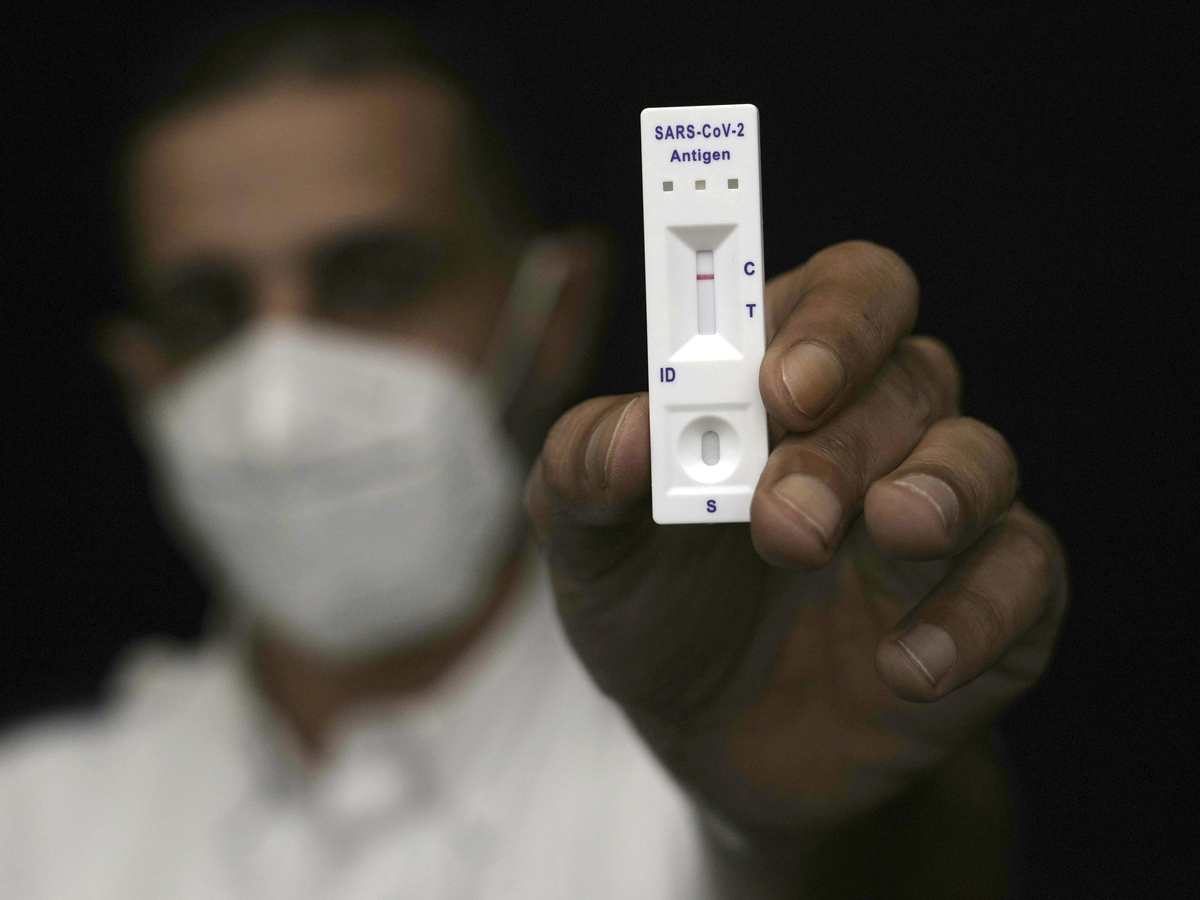
Fast antigen assessments are ubiquitous, however some People have discovered the laborious manner {that a} detrimental check consequence is not essentially the ultimate phrase.
Mahmoud Illean/AP
Because the COVID-19 pandemic enters its fourth 12 months, a detrimental consequence on somewhat plastic at-home check feels a bit much less comforting than it as soon as did.
Nonetheless, you dutifully swab your nostrils earlier than dinner events, wait quarter-hour for the all-clear after which textual content the host “detrimental!” earlier than leaving your KN95 masks at house.
It appears like the correct factor to do, proper?
The virus has mutated and then mutated once more, with the assessments providing at the least some sense of management because the Greek letters pile up. However some consultants warning towards placing an excessive amount of religion in a detrimental consequence.
So it is solely becoming to do a actuality verify on what these speedy COVID-19 assessments, additionally referred to as antigen assessments, can do — and what they can not.
Is the most recent omicron variant tripping up at-home assessments?
For essentially the most half, the reply isn’t any.
That is as a result of because the virus evolves, scientists are primarily seeing adjustments in its spike protein, which is what the virus makes use of to assault and enter wholesome cells. However the speedy antigen assessments aren’t really searching for that spike protein.
“[The tests] depend on detection of the nucleocapsid protein, which is the protein that’s straight encapsulating the viral RNA,” says Dr. Robin Colgrove, a professor at Harvard Medical College and chair of the Diagnostics Committee of the Infectious Illnesses Society of America.
He says this inside protein actually hasn’t modified a lot because the virus has mutated through the years. So, at the least for now, the speedy assessments can detect it.
Federal well being companies are monitoring the state of affairs in case that adjustments. The Meals and Drug Administration is working with the Nationwide Institutes of Well being to check simply how nicely the at-home assessments work because the virus continues to evolve.
Up to now, the companies have recognized just one check — the Luminostics Inc. Clip COVID Fast Antigen Take a look at — that has been rendered much less dependable within the face of latest variants. And even then, the FDA says “the impression doesn’t look like vital.”

Are antigen assessments taking longer to point out a constructive?
Some individuals report having detrimental antigen check outcomes for days, regardless of having a identified COVID-19 publicity and the telltale signs. Ultimately, they check constructive, however it could actually typically take so long as every week.
The phenomenon is considerably mysterious, says Colgrove. He acknowledges that medical doctors are seeing it, however thus far, it is solely anecdotal.
“What sort of an experiment would you must do to reply that query?” he says, explaining that it might be troublesome to check.
Many components may make it appear as if house assessments are taking longer to register a constructive consequence, such because the virus multiplying quicker someplace apart from the nostrils in some sufferers, says Dr. Geoffrey Baird, chair of the Division of Laboratory Drugs and Pathology on the College of Washington College of Drugs.
However Baird says maybe the most important issue is human error. In spite of everything, individuals doing these assessments at house make errors and are not skilled like those that are doing COVID-19 assessments in a lab.
“There’s going to be some individuals who stick it of their mouth,” he says, explaining that not everybody follows the testing directions as written. Some individuals even get mucus on the swab, mistakenly considering mucus could have loads of virus in it. “Truly you don’t need snot on the factor.”
And whereas, on common, individuals will get a constructive antigen check consequence across the time they develop into infectious, Baird says it is necessary to do not forget that there’ll at all times be loads of individuals on both aspect of that common: those that check constructive a lot sooner than most and people who check constructive a lot later.

How nicely do these assessments actually work?
Antigen assessments could be helpful in sure conditions (extra on that in a minute), however Baird stresses that they’ve their limits. That was true even earlier than the pandemic.
“Comparable expertise has existed for influenza for years and the advice was to not use them,” he says.
Antigen assessments search for particular proteins contained in the virus. Customers usually swab their nostrils, and the assessments take about quarter-hour to render a constructive or detrimental consequence. However these at-home assessments want way more virus to generate a constructive consequence than a PCR check, which is completed in a lab and entails letting hint quantities of viral genetic materials “amplify” over time — normally a day or so. So even when little or no virus is current, there needs to be sufficient to set off a constructive consequence (PCR assessments might also hold turning up constructive lengthy after somebody has cleared the an infection).
Each sorts of assessments have their benefits and downsides. And there are two measures of check efficiency to learn about: specificity and sensitivity.
Specificity is how good the check is at avoiding false positives. And sensitivity is how good the check is at discovering the virus.
In response to the CDC, antigen and PCR assessments are each good at avoiding false positives, however PCR assessments are usually extra delicate than house assessments. Which means antigen assessments aren’t all that helpful for ruling out COVID-19, however they are often useful for confirming that chilly actually is COVID-19.
If you have no signs although, do not depend on antigen assessments to offer you a definitive reply on whether or not or not you are within the clear. That is additionally what researchers discovered after they took a have a look at greater than 100 research of antigen assessments and revealed their findings within the Cochrane Database of Systematic Critiques this previous July.
“Fast antigen assessments are significantly much less correct when they’re utilized in individuals with no indicators or signs of an infection, however do carry out higher in individuals who have been involved with somebody who has confirmed COVID‐19,” they wrote.
The identical researchers additionally discovered that not all house assessments had been equally correct. Their evaluate included 49 completely different sorts of assessments.
“We noticed plenty of variation within the sensitivity of various manufacturers of assessments and our total outcomes mix findings from completely different research that evaluated the identical assessments,” lead writer Jacqueline Dinnes from the College of Birmingham stated in a podcast concerning the report.
So what are these assessments really good for?
Though it looks as if a good suggestion to have everybody take a speedy COVID-19 check the day of a gathering to verify they’re detrimental, consultants say that is not how the assessments had been meant for use.
“A constructive check is sort of at all times true,” Colgrove says. “So in an individual with an publicity or an individual with suggestive signs, in the event that they do a check and it is constructive, you are accomplished. You might have your analysis.”
It is a barely completely different story in case you are getting over COVID-19 and are testing to see whether or not you are still constructive.
However a detrimental “doesn’t rule out” a COVID-19 an infection, in response to the Facilities for Illness Management and Prevention. If somebody assessments detrimental, they’re purported to take one other antigen check 48 hours later to see if it turns constructive. And if that particular person has a identified COVID publicity or signs, the FDA recommends a 3rd check 48 hours after that.
One of the best ways to make use of the assessments is to know their limits and observe directions for retesting while you get a detrimental consequence.
“In an individual who had suggestive signs now, in the course of the epidemic the place the prevalence of the an infection is excessive, a single detrimental check isn’t sufficient to rule out an infection,” Colgrove says.
When you’ve got COVID-19 signs, even when your check is detrimental, it is a good suggestion to be cautious and simply keep house.


[ad_2]

